
ROOF LEAKS · REPAIRS · REPLACEMENT
Flat roof repair in St. Louis
Plenty of companies will tell you a flat roof needs replacing when it needs a seam repaired. We assess it and give you the best possible repair.
Tell us what you see Call (314) 328-4077
Leave us a message anytime.
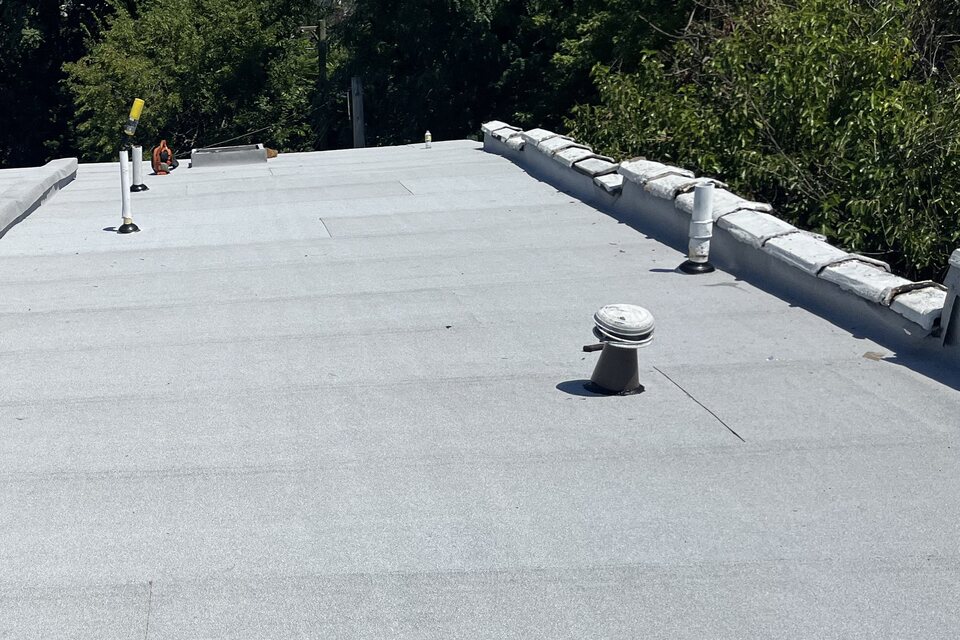
Where flat roofs fail
A flat roof fails in a few places, and they are not all the same repair. Seams open because the weld was missed, the tape let go, or the sheet moved. Ponding sits in a low spot until it finds one of those seams. Flashing splits where the roof meets a wall, a curb or a pipe. Blisters rise where moisture was trapped, and a blister that is still closed is not the same as a blister that has split. Punctures are the straightforward ones: a screw, a fallen tool, a branch, a foot in the wrong place.
Standing water is not a leak yet. It shortens the sheet and it hunts every weak seam. Often the honest repair is drainage, a cleared drain or a cricket, and not a new roof. A roof that ponds because the structure has settled may be past what a seam repair can do. We say which one it is after we have been on it.
The ceiling stain is still only a clue. Water on a flat roof travels before it falls. The repair is at the entry.
- Failed and lifting seams, re-welded or re-sealed
- Punctures, splits and open blisters in the membrane
- Flashing at walls, curbs and penetrations
- Ponding and drains that leave water standing
TPO, EPDM and modified bitumen
The repair has to match the sheet that is there. TPO is welded. A glued patch on a thermoplastic seam is not a repair. EPDM, the rubber sheet, is joined with tape or adhesive, and a weld meant for TPO does not belong on it. Modified bitumen, still common on older flat roofs here, is patched in the way that membrane was built. Using the wrong material is how a small leak becomes a larger one, and it is how a repair fails at the edge of the patch.
We repair all three. We also repair the metal edge and the flashings that meet them. We do not rename a rubber roof as TPO to make the bid sound newer, and we do not call a modified bitumen roof a candidate for a coating until the sheet and the insulation have been looked at.
Thickness, attachment and whether the roof was fully adhered or fastened are installation questions. They matter when the roof is being replaced. On a repair they matter because the patch has to live with the way the sheet was put down. The system pages on the replacement site describe the membranes. This page is the repair.
- TPO and EPDM, when the roof is being replaced
- Commercial roof repair
- The patch matches the membrane that is already on the roof
Coating as a repair
A coating can be the right repair on a flat roof that is still attached, still dry, and failing at the surface rather than in the insulation. Silicone and acrylic are not the same product, and neither one is a new membrane. A coating over a wet roof traps the water that is already there. That is why a coating is refused when the cuts are wet or the deck has failed.
When a coating is the honest next step, the scope and the limits are on the coating page. When it is not, we do not sell one to avoid saying the roof needs more than a repair.
When a repair is not enough
A repair is not enough when the insulation is wet across the area that leaks, when the deck is soft, when the sheet has shrunk off the walls, or when the ponding is the structure and not a clogged drain. Another patch on that roof spends the money twice. The honest sentence is that the roof needs to be replaced or recovered, and that work is a different scope.
Flat roof replacement, including commercial buildings, condos, additions and porches, is written on the flat-roofing page. Commercial tear-off and recover are on the commercial replacement page. We link them so you can read the job before you are asked to buy it. If a repair will hold, we still say that, including on a roof someone else has already called finished.
Clayton, Oakville and St. Louis County
Flat roofs in Clayton show up on porches, additions and low commercial buildings tucked among older houses. Oakville and the rest of south St. Louis County have the same mix: a membrane over a sunroom, a condo wing, a small commercial building with one drain in the middle. The failures are the ones above. The towns are examples inside the area this site already publishes, not a new map.
The block at the bottom of this page is the whole area, in the same order as every other page. We do not add a county by naming it here, and we do not cross the river. If the building is outside that area, we say so.
How a flat-roof repair runs
-
We walk the roof and find every place water can get in.
-
You get photos, a verdict — repairable or not — and a written price.
-
Repairs are made with materials matched to the existing membrane.
Before you choose a flat-roof repair
Questions we get
- My flat roof ponds after rain. Is that a leak?
- Standing water is not a leak yet, but it shortens a membrane's life and finds every weak seam. Often the fix is drainage, not a new roof.
- Do you repair TPO, EPDM and modified bitumen?
- Yes. The patch matches the sheet. TPO is welded, EPDM is taped or adhered, and modified bitumen is repaired in the way that membrane was built.
- Can a coating fix a leaking flat roof?
- Only when the roof is still attached and dry. A coating over wet insulation is the wrong product. The coating page says when a coating belongs.
- When do you tell me to replace it?
- When the insulation is wet, the deck is soft, or the sheet has failed in too many places for a repair to hold. Replacement is a separate page and a separate scope.
- Do you work on commercial flat roofs?
- Yes. The same seam, membrane and flashing repairs, on small and large commercial buildings. Occupied buildings are traced so the entry is found, not just the stain.
- Water is pouring in right now. Is that this page?
- That is emergency roof repair, including tarping. The emergency page says what to do right now, and what a tarp is for.
- Do you work in Clayton and Oakville?
- Yes. Both are inside St. Louis County, which is one of the areas at the bottom of this page.
- Do I get photos from the inspection?
- Yes. We photograph what we find and go through it with you, so you see what we saw.
- Who follows up when I send a request?
- Our office. Someone reads every request and calls you back to arrange a time to look at the roof. You can leave us a message anytime.
What you can check
- BBB Accredited, rated A+
- We pull the permit on every job that requires one.
- Our office reads every request and calls you back.
- Inspections documented with photos of what we found.
Where we do this work
- Jefferson County
- St. Louis City
- St. Louis County
- St. Charles County